
Airbnb’s Services Expansion: Former Executives on the CEO Behind the Pivot
Not whether Chesky has a vision, but whether the organization he built around himself can execute it.
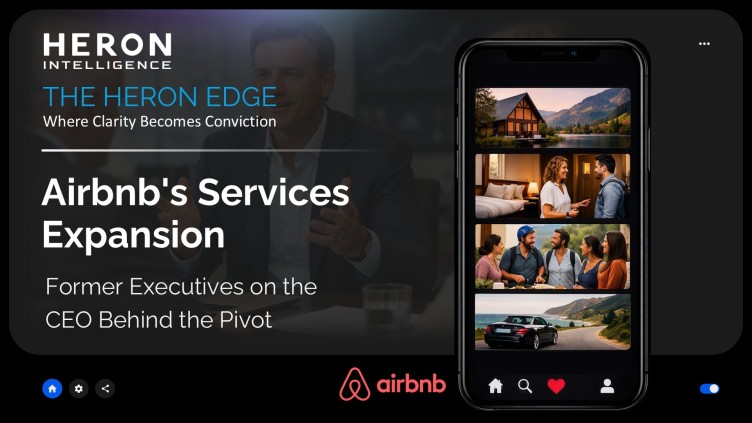

On May 20, Airbnb announced what CEO Brian Chesky called becoming “an Amazon for services” — boutique hotels in 20 cities, car rentals, luggage storage in over 15,000 locations, airport pickups, and a redesigned app built around services and experiences. It was the company's largest product expansion to date. Airbnb reports Q2 earnings on August 6, the first results since the launch.
In the weeks before the launch, Heron Intelligence conducted researcher-led management diligence interviews with former Airbnb executives across operations, product and strategy. What they described was not a question of whether Chesky has a vision, but whether the organization he built around himself can execute it. Four points stood out.
1. CEO Brian Chesky
What former executives said about him
Former colleagues gave Chesky mixed reviews. The most positive source, a former VP who departed in 2023, compared him to Steve Jobs and described a CEO who is deeply involved in every part of the business. The source said Chesky's life is the company, that he works relentlessly and expects the same commitment from everyone around him.
“He wants to be on the shelf with Walt Disney and Steve Jobs. His aspirations are that high. That's what he thinks about.”
Former VP, Airbnb (Departed 2023)
But the same source also raised a question that came up independently across the interviews: succession. The source said identifying a clear successor was difficult. A second former executive expressed similar doubts about whether anyone on the current leadership team could step into the role. A third raised concerns about the depth of the management bench below Chesky.
2. The post-COVID reorganization
Is founder's mode working in practice?
This matters for the services expansion specifically because of how Chesky has organized the company. After COVID, he reorganized Airbnb into a fully functional structure: no business units, no regional reporting lines, every function rolling up through SVPs directly to him. The approach has been widely described as founder's mode. One former executive who watched the transition described initially being impressed by Chesky's involvement but said the reality changed as the company scaled.
“He became the bottleneck. There were delays in execution. When a founder says, 'I want all major decisions to be escalated to me,' then the problem is, can you actually cope with the decision-making that is going to come your way?”
Former Executive, Airbnb (Departed 2024)
The same source described a pattern where senior executives had decisions reversed so often that they stopped making decisions on their own, opting to wait for Chesky's sign-off rather than risk having their calls overturned. The source described one project with significant revenue impact that took months of executive team meetings before anyone would approve it. The source raised a broader concern about accountability in the functional structure: when every function signs up to the same roadmap and the same metrics, nobody individually owns the number.
3. From short-term rentals to personal travel concierge
A first for Airbnb
One former executive described the transformation Chesky is now attempting: moving Airbnb from a short-term accommodation platform to a personal travel assistant. The source described a vision where the app handles everything from massages to tour guides to personal chefs, all integrated into the booking experience, before, during and after the trip.
“He's trying to do a massive transformation of the company from just being a short-term accommodation play to your personal travel assistant on your phone. That's not something that he built initially.”
Former Executive, Airbnb (Departed 2024)
The source noted that this shift creates a three-party marketplace — hosts, guests and now service providers — and said Airbnb had been hiring from Uber and DoorDash specifically because those companies understand how to manage three-sided platforms.
4. The AI question
Where it fits into the expansion
One former executive called the missed opportunity to partner with OpenAI the company's biggest failure, despite Chesky and Sam Altman being close friends. A separate former executive framed the problem differently: the Airbnb app is antiquated, and the services expansion needs a strong AI infusion to work. That source said the new CTO hire from Meta was a good move for exactly this reason.
“He lost touch with reality in the sense that reality is about how you make everything leaner and lean very heavily on AI. I think that was a big miss.”
Former Executive, Airbnb (Departed 2024)
Whether the new CTO can close the gap fast enough is one of several open questions the services launch raises. The functional organization Chesky built means one person holds the decision-making authority. Former executives raised the question of whether that structure can support a transformation into hotels, car rentals, luggage storage and services, all at once. That is what they said they were watching.
Questions to watch
- Whether the three-party marketplace — hosts, guests and service providers — introduces execution complexity that the current functional org structure can absorb.
- How the new CTO from Meta addresses the AI gap.
- Whether Chesky delegates execution authority as the services expansion scales, or remains the bottleneck.
- Whether the first full quarter of the services expansion validates or compounds the execution concerns.
This material is provided for informational purposes only and does not constitute investment advice, a recommendation, or an offer to buy or sell any security. Heron Intelligence is not a registered investment adviser. Quotes are the personal opinion and recollection of former employees speaking about periods that had ended, not statements of fact by Heron. Past performance is not indicative of future results.