
Former Executives Saw Fiserv's Problems Months Before the Market Did
Three structural concerns raised before the guidance cut — and the stock decline that followed.
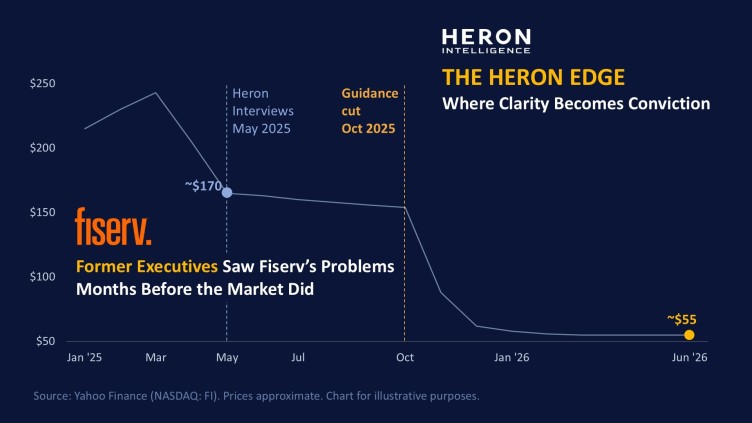

In May 2025, Heron Intelligence interviewed former executives with direct experience at Fiserv and PNC Financial Services. Mike Lyons had just left the presidency of PNC to take over as CEO of Fiserv. The former executives described a company carrying deep structural problems that had been building for years: a hollowed-out talent base, core technology running on decades-old platforms, and a flagship product not delivering on its promise.
In October 2025, Fiserv cut guidance. The stock, which was trading at approximately $170 when the interviews were conducted, has since fallen to roughly $55, a decline of approximately 68%.
1. The institutional knowledge had already walked out the door
The people who built the platforms were gone
Former executives described a mass departure of experienced talent following years of return-to-office mandates and cost cuts. The people who had built Fiserv's platforms, and knew how to maintain and fix them, were gone. One source estimated 5 to 15 years of knowledge transfer problems ahead.
“There's not a lot of innovation happening, because the innovators left.”
Former Executive, Fiserv (2018 to 2023)
2. Core technology was aging with no credible path to modernization
Billions of capital the company did not have
Sources described core banking platforms running on decades-old technology. Modernization would cost billions, capital the company did not have. Platform issues were already taking longer to resolve, and the workforce that could fix them quickly had left.
“All these cores are running on 45-year-old tech. There's no innovation happening in the core banking business space at all.”
Former Executive, Fiserv (2018 to 2023)
3. Clover was not delivering what it had been sold as
Not as integrated as marketed
A former executive with direct visibility into Fiserv's banking and merchant operations said the technology behind Clover was not as integrated as marketed. Small business owners were not seeing the outcomes the product had promised.
“The technology behind Clover wasn't as integrated as they sold it… didn't work as advertised.”
Former Senior Executive, Fiserv (2025)
What sources said about the incoming CEO
Positive on the person, uncertain on the fit
Mike Lyons joined Fiserv as CEO in May 2025, leaving the presidency of PNC Financial Services. Former PNC executives described Lyons as exceptionally smart, data-driven and effective at attracting talent. One turned down another job offer to work for him. Another gave him an 8.5 to 9 out of 10 rating. Multiple sources noted he had deep expertise in treasury management and payments, and had overseen a major enterprise systems overhaul at PNC. No source raised concerns about his ethics or integrity.
At the same time, sources at both companies raised questions about fit. Former Fiserv executives were surprised the board went outside the company and noted that Lyons had not previously run a technology business. One source believed his M&A background signaled the board's intention to restructure or spin off parts of the business. PNC sources noted a pattern of getting too deep into detail and becoming a bottleneck on decisions, a tendency they said improved over time but which raised questions about his operating style at a larger, more complex organization.
“I think he has the senior leadership skills to drive this company. That's not a problem. I'm hearing very good things about him.”
Former Senior Executive, Fiserv (2022 to 2024)
Former executives were largely positive on Lyons personally. The structural problems they described at Fiserv predated his arrival. Whether any CEO could have reversed years of accumulated technical debt and talent loss in the timeframe available is a question the transcripts raise but do not resolve.
What happened next
Then management confirmed it
In October 2025, Fiserv cut guidance. The stock collapsed. As of June 2026, shares trade at roughly $55, approximately 68% below the $170 level at the time of Heron's interviews in May 2025. The structural concerns former executives raised — depleted talent, aging platforms, unresolved product gaps — appeared to play out in the numbers.
In the Q3 2025 earnings release, Fiserv's own management acknowledged that deferred investments and cost cuts designed to boost margins in the short term had hampered the company's ability to serve clients and execute product launches. The language used by management echoed the concerns former executives had described to Heron months earlier.
Mike Lyons, who became Fiserv's CEO in May 2025, has since departed and was appointed CEO of Truist Financial in June 2026.
Questions to watch
This material is provided for informational purposes only and does not constitute investment advice, a recommendation, or an offer to buy or sell any security. Heron Intelligence is not a registered investment adviser. Quotes are the personal opinion and recollection of former employees speaking about periods that had ended, not statements of fact by Heron. Past performance is not indicative of future results.