
Can a CEO's Playbook Transfer? Intel Under Lip-Bu Tan
A proven turnaround leader takes on a far bigger challenge. Our interviews asked a different question: does the playbook actually fit?
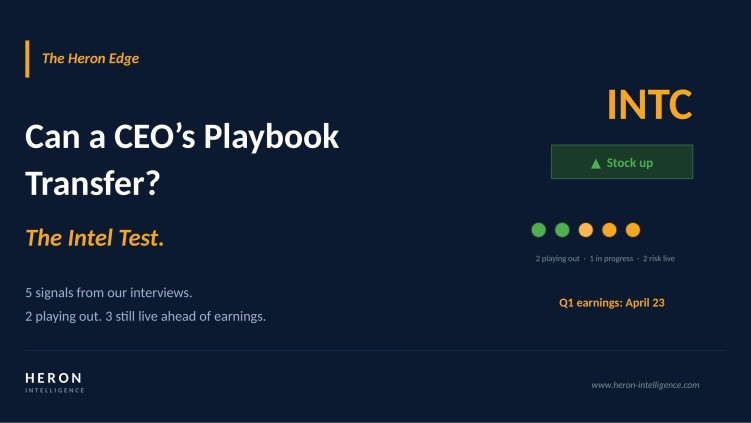

In March 2025, Intel appointed Lip-Bu Tan as CEO. Tan spent the prior 12 years as CEO of Cadence, where he took the stock from around $3 to over $130 per share, a return of more than 3,200%. He is widely regarded as one of the most connected executives in semiconductors. The stock is up approximately 170% since his appointment.
In mid-2025, Heron Intelligence conducted structured management interviews with former Cadence executives who worked directly with Tan. Across those conversations, five signals stood out. Two have since begun playing out publicly. Three remain unresolved ahead of Q1 earnings on April 23.
1. A specific turnaround playbook, described in detail before it became public
Customers first, then several layers down
People who worked closely with Tan describe a clear pattern. He starts by asking every major customer what's working and what isn't. Inside the organization, he doesn't rely solely on what senior leaders tell him; he talks directly to the people doing the work, often several layers down, to understand the real problems. He then rebuilds the company's focus around making better products than the competition. At Cadence, he visited 300 customers in his first year. Sources noted that he had already begun replacing senior leaders at Intel within his first year and had personally taken over AI strategy.
Where things stand: Intel has announced restructuring and leadership changes. Tan appointed a new head of graphics chip design in February 2026, saying it took “some persuasion.” Public messaging now emphasizes engineering focus and customer partnerships.
2. An industry network described as unparalleled, now visibly in play
First-name friendships with rivals
Across our interviews, one theme emerged repeatedly: Tan's personal relationships within the semiconductor industry are unusually deep. He is on a first-name basis with Jensen Huang of Nvidia and senior leaders at TSMC, the world's largest chip manufacturer and Intel's primary rival. As one source put it: “He has first-name friendships with people that he should be at war with.” Sources noted that this network allows him to bypass normal channels and go straight to decision-makers.
Where things stand: Intel has since announced partnerships with Google, a $5bn collaboration with NVIDIA, a landmark deal with Elon Musk's Terafab project, and chip manufacturing agreements with Amazon. Whether these convert to sustained, large-scale production remains to be seen.
3. Next-generation chip manufacturing is the single biggest risk
If the process fails, the rationale for the factories may collapse
Our interviews surfaced a consistent view: if Intel's critical next-generation chip manufacturing process failed to deliver, the strategic rationale for maintaining the company's chip factories may collapse. Sources described the rate of usable chips coming off Intel's production lines as far behind that of industry leader TSMC, and noted that the timeline had already slipped repeatedly over several years.
Where things stand: This new manufacturing process entered mass production in January 2026, and Intel's first chips built on it are now shipping. However, Intel's CFO stated recently that production quality is “adequate to address supply” but “not where we need them to be.” Full production efficiency is expected in 2027.
4. The technology gap is fundamentally different from Cadence
Behind on three fronts at once
Our interviews flagged a critical distinction. At Cadence, the product “wasn't miles behind the competition.” Intel is behind simultaneously on chip manufacturing (TSMC), processors (AMD) and AI compute (Nvidia). Sources described resurrecting Intel as “significantly more difficult than resurrecting Cadence.”
Where things stand: The stock has risen sharply, up roughly 170% since Tan's appointment. However, Intel's business of manufacturing chips for other companies remains loss-making. Sources described this as a multiyear effort requiring patience.
5. A leadership style built for boardrooms, not for rallying a workforce
The contrast that came up explicitly
Our interviews surfaced a notable observation: at Cadence, Tan was not known for inspiring company-wide communication, and sources could not recall a particularly inspiring public address during his tenure. The contrast with Jensen Huang's ability to rally large organizations was raised explicitly. Sources also observed that Tan's predecessor, Pat Gelsinger, had technical credibility but lacked boardroom skills, and that Intel may need both profiles.
Where things stand: Tan is scheduled to give a keynote address at COMPUTEX in June 2026. Whether this signals a shift in approach is unclear from public information. The talent question remains difficult to assess externally.
Questions to watch
This material is provided for informational purposes only and does not constitute investment advice, a recommendation, or an offer to buy or sell any security. Heron Intelligence is not a registered investment adviser. Quotes are the personal opinion and recollection of former employees speaking about periods that had ended, not statements of fact by Heron. Past performance is not indicative of future results.